Showing posts with label Macedonia. Show all posts

Monday, August 8, 2016

Help needed for the victims affected by the heavy rain and flooding in Macedonia

The Macedonian Red Cross is on the ground helping the victims affected by the heavy rain and flooding in Macedonia. 

At least 22 people are confirmed dead and many more are injured or missing. If you would like to help bring much needed aid to the victims of the floods, please consider making a donation to the Macedonian Red Cross!

--DONATIONS OUTSIDE OF MACEDONIA--
Name of Organization: MACEDONIAN RED CROSS
Bank Name: KOMERCIJALNA BANKA AD SKOPJE
Bank Address: UL. ORCE NIKOLOV NO.3, 1000 SKOPJE, MACEDONIA
Bank Account: 300000000000133 25730522-11
Swift Code: KOBSMK2X
IBAN Code: MK07300701000001228
--DONATIONS INSIDE MACEDONIA--
Call 143-400 to make a 100 MKD donation!
Solidarity Fund of the Macedonian Red Cross Bank account: 300000001327966
Tax number:4030984271620 AD KOMERCIJALNA BANKA
Donations of food, clothing, footwear, hygiene, bedding and other articles can be delivered to local Macedonian Red Cross Branches throughout Macedonia.

Sunday, June 19, 2016

If you lose your identity, you are a nobody

...If many Macedonians sound insecure about their identity, they have reason to be. Greece accuses Macedonia of trying to appropriate its history. In fact, Greece insists that Macedonia change its name. 

But Macedonian cultural anthropologist Aleksandar Ristevski said his compatriots have already done more than enough to appease the Greeks.

“We changed our flag, we are calling ourselves internationally the former Yugoslav republic of Macedonia, mentioning a country which doesn’t exist for 20 years using some idiotic acronym. We changed the constitution because of them. We changed millions of things. What did we get? Blockage, degradation and sanctions,” Ristevski said...

(full article)


...“If you lose your identity, you are a nobody,” said Alexandar Ristevski, 32, an ethnographer.
Macedonia was promised an invitation to join NATO in 2008, but this was vetoed by Greece because the name issue was unresolved. In 2005, Macedonia also became a candidate for the European Union, but still has no date to start accession talks because of Greek resistance...

(article in New York Times)

Wednesday, June 15, 2011

Alexander The Great rides back home to Macedonia

(Skopje, Macedonia) Since early this morning, big trucks are headed towards the central square, Plaza Macedonia. Alexander is coming!


A statue, almost 13 meters high, on a pedestal 15 meters high, will make the center of the capital spectacular.  The fountain, with the sculpture, is expected to be completed in a few weeks. 

Enjoy the sites, and visit Skopje.


Tuesday, May 3, 2011

A Spectacular Premiere of “Dracula” at the April Ballet Evenings 2011

The premiere of the spectacle entitled “Dracula” performed by Vortice Dance Company from Portugal and supported by their Macedonian counterparts took place on Friday (29 April) at the closing ceremony of the first ever April Ballet Evenings 2011 at the Macedonian Opera and Ballet.


Rafael Caricco and Claudia Martins were the people responsible for the choreography of this amazing ballet spectacle with music from Voyceh Kilar, Phillip Glass, Rachmaninoff and Lou Reed. Rafael Caricco was the genius behind the stenography, videography and sound effects, Claudia Martins was woman behind the costimography, while audio-visualization and technical director was João Neves. Light design of  Luis Paz and João Teixeira.

The soloists in “Dracula” were the amazing Aleksandra Mijalkova, Mimi Pop Aleksova, Biljana Basmadzieva, Ivana Kocevska, Igor Velanoski, Cláudia Martins, Rafael Carriço, Boban Kovachevski, Trajche Stojkovski, Jorge Libório, Simona Vasilevska, Jan Kisilev, Razvan Mazilu, Gabi Pavlovska,  and Lile Milenkovska.

Dracula… An attack on all senses! How else could we describe what went on the stage of MOB on Friday?

Wednesday, October 13, 2010

ZOO Skopje photo galery

Enjoy the pictures taken in the ZOO in Skopje, Republic of Macedonia in the past few months.

Show them to your friends, spread the good word about the Skopje Zoo and of course, visit it! ;-)


Monday, August 2, 2010

Macedonians in USA in 1899

Macedonian a "race" according to US Bureau of Immigration 1899!


Macedonian is mentioned as a separate race in Turkey in Europe, Bulgaria and Greece, used by the United States Bureau of Immigration since 1899.

“The Economic Investigations of the United States Immigration Commission” by W. Jett Lauck, published in “The Journal of Political Economy”, Vol. 18, No. 7, (Jul., 1910), pp. 525-549. This is from page 527.


Check out the facebook group: Macedonian Documents

Tuesday, June 29, 2010

I am Macedonian

One of our biggest God given rights is to declare our selves for who we are.


Unfortunately, some of us don't have that right.


Check out the video, and you will find out, what are Macedonians going through their history, and what is their presence like. 


One name, one love, one Macedonia.

Wednesday, June 23, 2010

"Macedonia for Macedonians" rally 1922 in the USA

This video is from a rally in United States, organized by the Macedonian commune.


Even though some people say that Macedonians are new, artificial nation, without past, a nation created after World War II, this shows the movement of the Macedonians in 1922.


Macedonian community in the United States of America got organized in 1922 in Fort Wayne, Indiana. Since then, this organization (MPO) and all the other organization of the Macedonians, in some period were usurped by people who were spreading mainly Bulgarian, and sometimes Greek propaganda. 


Through the years, most of the neighboring Balkan countries, tried to usurp Macedonian history and identity, and by doing that to cover up the segregation of the Macedonians after the Balkan Wars in 1912 - 1913. Let us not forget the genocide over the Macedonian population in Kingdom of Yugoslavia, Bulgaria and Greece in the twenties and the thirties, especially in Greece during and after the Greek civil war 1946 - 1449 .


Macedonians strongly set themselves on the idea of having their own country. Since 8th of September 1991, that idea became reality. Republic of Macedonia is a motherland for all the Macedonians around the world and strength that holds them together.


MACEDONIA FOR MACEDONIAN. UNITED MACEDONIA!

Wednesday, June 2, 2010

Sculptures in the city center Vol.2

Almost two moths ago I had a post with some of the sculptures in the city center of Skopje, Republic of Macedonia.

Here are some of the other statues that you can see, if you visit our capital. Visit Skopje, visit Macedonia.


Wednesday, May 12, 2010

CNN - Creating Napa Valley in Macedonia

One more article on Macedonia, on the series of articles promoting the country.

This time Nic Robertson visits Jordan Trajkov, the owner of Popova Kula Winery in the Tikvesh region. 

You can see the Macedonian potential in the wine industry, as well as the possibility to travel around the country and check out all the natural beauties, and the cultural heritage.

Republic of Macedonia. Cradle of culture. Land of nature. 

Macedonia. Timeless.


Monday, May 10, 2010

CNN on Macedonia's name issue

The World media finally decided to spend some time, and analyze the "Macedonian issue", the name dispute and the meaningless requests by the Greek government.

The reporter Nic Robertson plastically presents the current situation, interviews the Prime minister Nikola Gruevski, and shows a new perspective on the whole problem.

I think that finally is the time for the World to know that Macedonia is mobbed by Greece, and that all international law are broken in this despute with no ending.


Monday, April 12, 2010

Sculptures in the city center Vol.1

Here are some of the sculptures in the city center of Skopje, the capitol of Republic of Macedonia. 

The sculptures are situated on the main pedestrian street Macedonia and the national plaza Macedonia.

Enjoy the view.


Sunday, March 14, 2010

Council of Europe: Committee on Legal Affairs and Human Rights slaps Greece on minority issue

Check out the official document on Greece:

Case study: Greece

77. Since the monitoring procedures set up under the framework convention and the European charter do not formally apply to states that have not ratified them, these states escape scrutiny by the advisory committee (but they are monitored by other Council of Europe bodies). It is nevertheless most interesting to examine how these countries accommodate diversity, whether through minority policies with respect to recognised minorities or through a "non-discrimination" approach when minorities are not recognised, or by combining both approaches. In the context of this report, I therefore decided to visit one of these countries, namely Greece, which recognises only one minority on its territory. From 26 to 28 February 2009, I had a number of meetings in Athens, Thessaloniki and Florina (see the programme of the visit in Appendix III).

78. In its 2004 report on Greece, the ECRI noted, “persons wishing to express their Macedonian, Turkish or other identity incur the hostility of the population. They are targets of prejudices and stereotypes, and sometimes face discrimination, especially in the labour market”.24 In its 2009 report on Greece,25 the ECRI expressed concern about the situation of Roma, which suffer discrimination in particular in education, housing and employment.26 It also noted that the problem of the recognition of the identity of Macedonians and ethnic Turks, and in particular their right to freedom of association, remains. 27

79. Given that other reports of the Parliamentary Assembly’s Committee on Legal Affairs and Human Rights address the issue of the Muslim minority in Thrace (Eastern Greece), as well as the situation of Roma in Europe,28 I limited my focus to the contentious issue of the Macedonian community in Greece, which has, inter alia, also been recently dealt with, to various extents, by the Council of Europe’s Human Rights Commissioner and the United Nations independent expert on minority issues, Ms Gay McDougall. The latter also visited Florina in September 2008. 29

-        The approach of the Greek Government

80. The Greek authorities recognise only one minority in Greece, namely the ‘Muslim’ minority in Western Thrace, by virtue of the Lausanne Peace Treaty of 24 July 1923. In this context, Greece was recently commended by various bodies, including the Parliamentary Assembly’s Committee on Legal Affairs and Human Rights,30 for a number of measures it had taken to enhance the rights of the Muslim minority in Greece. As regards others, Greece favours the approach to non-discrimination defined by European Union instruments.31

81. The Greek authorities have repeatedly denied the existence of any Macedonian minority in Greece and repeatedly referred to the hijacking of local culture by persons and groups which pursue political aims.

82. Despite the non-recognition of any other national or linguistic minority, the Greek authorities have acknowledged that in northern Greece there exist “a small number of persons who … use, without restrictions, in addition to the Greek language, Slavic oral idioms, confined to family or colloquial use”.32

83. During my visit, the Greek authorities stressed that Greek citizens who claim Macedonian identity are fully represented by a political party, which is free to participate in elections in Greece.

-        Claims of representatives of the Macedonian community

84. First and foremost, I should stress that there has not been any ethnic violence in the Florina area. Greek society is pluralistic and open to diversity. Nevertheless, it seems that still today, persons who express and actively claim a Macedonian identity often come up against the resentment and even hostility of the authorities.

85. Members of the Macedonian community recognised that their situation had improved in the last 15 years, though they were still allegedly subject to individual acts of harassment and intimidation (at work, to get Greek citizenship, when crossing the border with the neighbouring country, for recognition of diplomas, for property issues or in religious matters). They ask the authorities to recognise their right to self-identification as well as the existence of a Macedonian national minority in Greece.

Monday, February 8, 2010

Magic by Goran Pandev

Pandev continues to shine in Inter Milan's jersey.

 Today, he scored once again. He opened the result with a goal in the 6 minute, after which the game was lot more interesting. The other two goals were scored by Diego Milito and Walter Samuel.

Pandev shows a standard form in Inter's jersey and only after 5-6 matches became an important factor in the "nero azzuri" squad. The fans love him and proves once again that he was a good investment.

Friday, February 5, 2010

Vision of Skopje 2014

Yesterday (thursday, february 4th 2010) in Skopje, in one of the most prestigious hotels 'Aleksandar Palace', the Ministry of Culture, Municipality of Centre and Skopje Metropolitan Local Government presented the architectural vision for the capital in year 2014.

The video simulation presented the objects, statues, monuments and facade reconstructions which are in construction or planed to be done, in the next four year period.

There is big discussion between the public in Macedonia should this project go on. On one side there are people who totally support it, and on the other there are some who are totally against it.

Personally, I am impressed and fascinated. Skopje will have one of the most beautiful city centres.


Wednesday, November 18, 2009

Macedonia drawed against Iran in Teheran

Teheran, Iran - Macedonia drawed against Iran on Azadi Stadium in today's friendly.


Iran - Macedonia 1-1 (1-0)
Friendly Match, Teheran

Goals: 1-0 Teymourian (36' / Assist by Meydavoudi)
1-1 Pandev (49')

Today's friendly soccer match was a chance to check the capacity of both squads. On such a rainy day, both teams had one half to show their skills.


Iranian coach Afshin Ghotbi played with the following team: Rahmati - Kaebi, Aghili, Nosrati, Beikzadeh - Teymourian, Nekounam (46' Mobali) - Kazemian (46' Khalatbari), Shojaei (76' Ansarifard), Madanchi (57' Heydari) - Meydavoudi (67' Borhani).

Macedonian squad led by Mirsad Jonuz selected the following players:

Goalkeepers: Tome Pachovski - Germinal Beerschot, Belgium; Kristijan Naumovski - Rabotnicki, Macedonia;


Defenders: Goce Sedloski - SV Mattersburg, Austria; Vlade Lazarevski - FK Karpaty Lviv, Ukraine; Goran Popov - SC Heerenveen, Netherlands; Nikolce Noveski - FSV Mainz 05, Germany; Daniel Mojsov - FK Makedonija Gjorce Petrov , Macedonia; Robert Popov - Auxerre, France;

Midfielders: Veliche Shumulikoski - Preston North End, England; Filip Despotovski - FK Vorskla Poltava, Ukraine; Armend Alimi - NK Istra, Croatia; Slavco Georgievski - Ulsan Hyundai, South Korea; Gligor Gligorov - Sileks, Macedonia;

Strikers: Goran Pandev - SS Lazio, Italy; Aco Stojkov - FC Aarau, Switzerland; Filip Ivanovski - Polonia Warszawa, Poland; Besart Ibraimi - FK Renova, Macedonia; Dusan Savić - Rabotnicki, Macedonia.


The few spectators saw an even first half under pouring rain, in which the Macedonians had the better chances, but faild to convert, while Iranians mainly relied on shots from far out, which mostly were all but dangerous.

One such effort led to the homeside's lead in minute 36. Meydavoudi smacked a freekick on goal and Pachovski could not hold on to the wet ball, so Teymourian tapped in the rebound from close range.

Macedonia responded just four minutes into second half, when a cross from the right side found superstar Pandev on the far post, who perfectly headed the ball past the chanceless Mehdi Rahmati.

Iran now created more chances than in first half, but Iman Mobali (51' / shot), Mohammad Nosrati (52' / header), Teymourian (55' / shot) and Masoud Shojaei (64' / volley) faild to bring Iran back in front.

On the other side Macedonia remained dangerous through counter attacks, but Pandev (49') and Ibraimi (65') were denied by Rahmati.

Iran looked more eager to win than the guests during the final minutes, but saw a Hadi Aghili header saved by the goalkeeper, seven minutes from time.

Tuesday, November 17, 2009

Croatia beats Macedonia in FINA's World League match in Skopje

Skopje, Macedonia - FINA's World League debut match for Macedonia. Swimming poll "Mladost", attendance 600. The result 7-9 (1-1; 3-3; 1-3; 2-2) for Croatia.


Macedonian national water polo team had a great debut, even though Croatia won the match at the end.

Croatian team led by water polo legend Ratko Rudic came to Skopje with with a few newcomers. Macedonian coach Nonkovic put an a good strategy, pressuring the Croats all over the field.


The first two periods were tied. A few seconds before half time Macedonian led by 4-3, but Croats scored and went on break with draw.

The game was finally decided in the third quater. Croats played more agresively, and scored 3 goals more, recieved only one.
At one point in the fourth quater, Croats led by 4 goals (9-5).

Macedonia scored twice before tha match was over, and showed that they are a team to be respected and feared in this group.


Macedonia will take on Greece in the next match, in Athens.

Saturday, November 14, 2009

Macedonia trashes Canada in soccer friendly in Strumica

Macedonian national soccer team demolished the Canadians in the friendly match in Strumica, in the south-east part of Macedonia.

In front of 4500 spectators, Macedonian national team led by italian SS Lazio star, Goran Pandev started slowly. In the first 45 minutes, even though the Macedonian players controled the ball, and created chances it was draw, with no scoring.

The second half was opened after only 3 minutes, when the ex-captain of the national team, Goce Seldoski scored with a header.
1-0 Macedonia leads.

In the 56 minute, Ibraimi play with the hand in the 16, referee Genhcev gives penaly for Canada. Hume misses the goal.
Just 5 minutes later, duel between Dusan Savic and Paul Stalteri in the Canadian penalty area. Genchev puts the ball on 11 meters, Pandev scores.

2-0 for Macedonia.
One more penalty for Canada in the 69 minute. Mojsov fouls Rob Friend, Tome Pachovski once again undefeated. Jackson shot was saved by the macedonian goalkeeper.
In the extra time, on more penalty. Kevin McKenna stops the macedonian midfielder Despotovski, Goran Pandev scores once again with a exhibition shot.

3-0 Macedonia.

This match was the 98'th cap for the ex-captain Goce Sedloski, the 39'th and fairwell match fot the ex-national team player Goran Stavrevski, and a national team debut for the U-23 goalkeeper Kristijan Naumovski.

Friday, October 23, 2009

Aegean Refugee Children Golgotha (1946 - 1949)

Political refugees of the Greek Civil War were members or sympathisers of the defeated communist forces who fled Greece during or in the aftermath of the Civil War of 1946–1949. The collapse of the Democratic Army of Greece (DSE) and the evacuation of the Communist Party of Greece (KKE) to Tashkent in 1949 led thousands of people to leave the country. 

It has been estimated that by 1949 over 100,000 people had left Greece, including tens of thousands of child refugees who had been evacuated by the KKE in an organised campaign. The war wreaked widespread devastation right across Greece and particularly in the regions of Macedonia and Epirus, causing many people to continue to leave the country even after the end of the war.


Many people fled due the collapse of the DSE, it has also been claimed that many ethnic Macedonians fled to avoid possible persecution by the advancing National Army. A term used to describe the experience of the ethnic Macedonians who left Greece as a result of the Civil War is the Exodus of Macedonians from Greece, particularly in the Republic of Macedonia and the ethnic Macedonian diaspora. 

The KKE claims that the total number of political refugees was 55,881, an estimated 28,000 - 32,000 children were evacuated during the Greek Civil War, A 1951 document from the Socialist Federal Republic of Yugoslavia states that the total number of ethnic Macedonians that left Greece during the Civil War was 28,595 whereas some ethnic Macedonian sources put the number of refugees at over 213,000.


On March 4 1948, "Radio Free Greece" announced that all children under the age of 15 would be evacuated from areas under control of the Provisional Government. The older women were instructed to take the children across the border to Yugoslavia and Albania, while the younger women took to the hills with the partisans. 

Widows of dead partisans soon became surrogate mothers for the children and assisted them in their journey to the Eastern Bloc. Many people also had their children evacuated. 

By 1948 scores of children had already died from malnutrition, disease and injuries. It is estimated that 8,000 children left the Kastoria area in the ensuing weeks. The children were sorted into groups and made way for the Albanian border. The partisan carers (often young women and men) had to help and support the children as they fled the Civil War.


Thousands of Greek, ethnic Macedonian and Aromanian children were evacuated from the Areas under communist control. Although a United Nations Special Committee on the Balkans (UNSCOB) report confirms that villages with an ethnic Macedonian population were far more willing to let their children be evacuated. They are now known as „Децата Бегалци “ (Decata Begalci) "the Refugee Children" in the Republic of Macedonia and the ethnic Macedonian diaspora. 

It is estimated that from 28,000 children to 32,000 children were evacuated in the years 1948 and 1949. According to some sources, the majority of the children sent to the Eastern Bloc had an Ethnic Macedonian origin and spoke their native Slav vernacular, but this is disputed by official KKE documents and statements made by political refugees in the years after the evacuation. Exceptions were made for children under the age of two or three who stayed with their mothers while the rest should be evacuated. 

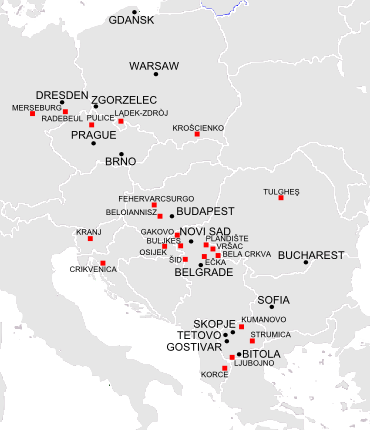
Many of these children were spread throughout the Eastern Bloc by 1950 there were 5,132 children in Romania, 4,148 in Czechoslovakia, 3,590 in Poland, 2,859 in Hungary and 672 had been evacuated to Bulgaria.

The official Greek position was that these children had been forcibly taken by the Communists to be brought up under a socialist system. The alleged abduction of children is referred to by Greek historians and politicians as the Παιδομάζωμα (Paidomázoma), an allusion to the Ottoman devşirme.

One major effect of the Macedonian exodus from Northern Greece was the effect of depopulation on the region of Greek Macedonia. This was most markedly felt in the Florina, Kastoria, Kozani and Edessa areas where the Communist party was popular and where the largest concentrations of Ethnic Macedonians could be found. Many of these depopulated and devastated villages and confiscated properties were given to people from outside of the area. 


Vlachs and Greeks were given property in the resettlement programme conducted by the Greek Government from the period 1952-58. Many properties were confiscated from those persons who had fled the war and had their citizenship subsequently stripped from them.

Law 1540/85 of April 10,1985 stated that political refugees could regain property taken by the Greek government as long as they were “Greek by genus”. This again excluded many people who were not "Greek by genus", namely the ethnic Macedonian refugees.

Citizenship was stripped from the evacuees without the fair hearing to an independent tribunal and other internationally accepted protocols for the seizure of citizenship such as legal representation and the opportunity to defend oneself. This process of seizing citizenship had "historically been used against people identifying as ethnic Macedonians". Despite it applying to all citizens regardless of ethnicity. 


It has been enforced, in all but one case, only against citizens who identified themselves as members of the "Macedonian" minority. Dual citizens who are stripped of Greek citizenship under Article 20 of the citizenship code are sometimes prevented from entering Greece using the passport of their second nationality. Although since 1998 there have been no new reported cases of this occurring.

Many people who had fled the country were also denied visa for re-entry into Greece. The refugees planned on attending weddings, funerals and other events but were denied access to Greece. These measures were even extended to Australian and Canadian citizens, many of whom have been barred from entering Greece. 


There have been claims that specifically the exiles who left Greece were especially targeted while other nationals from the Republic of Macedonia have had very little problems with entering Greece. The Greek Helsinki Monitor has called on the Greek government to stop using articles of the Citizenship code to deprive, "non-ethnic Greeks", of their citizenship.

_____________________________

Due to all of this, the refugee children took a lawsuit against Republic of Greece in from of the International court in The Hague. They are looking back for their property as well as the right for double citizenship. Estimated value of the lawsuit is around 40 billion euros.

Wednesday, August 12, 2009

Bela - Karolina i Aki Rahimovski

"Bela" is originaly performed some 10 years ago, by the macedonian artist, Risto Samardziev. This new version of the song is a duet between one of the greatest macedonian music stars, Karolina Gočeva and Aki Rahimovski.

Karolina Gočeva (Macedonian Cyrillic: Каролина Гочева) (born April 28, 1980, in Bitola,Republic of Macedonia) is a Macedonian singer. She represented Macedonia in the 2002 and 2007 Eurovision Song Contests, ranking 19th and 14th, respectively. She became the first female Macedonian to represent Macedonia twice at Eurovision.

Aki Rahimovski
(Macedonian Cyrillic: Аки Рахимовски) (born 1953 in Nis, Serbia, raised in Skopje, Macedonia, where his family is from) is a ex-lead singer of Parni Valjak. Parni Valjak ("Steamroller") was a Croatian and former Yugoslav rock band from Zagreb. They were one of the top acts of the former Yugoslav Rock scene.

Parni Valjak was founded in 1975. Unlike many rock bands that would come later, their style was becoming more mainstream, becoming closer to pop, especially compared with the bands like Prljavo Kazalište or Film.