Showing posts with label careca. Show all posts

Wednesday, June 15, 2011

Alexander The Great rides back home to Macedonia

(Skopje, Macedonia) Since early this morning, big trucks are headed towards the central square, Plaza Macedonia. Alexander is coming!


A statue, almost 13 meters high, on a pedestal 15 meters high, will make the center of the capital spectacular.  The fountain, with the sculpture, is expected to be completed in a few weeks. 

Enjoy the sites, and visit Skopje.


Thursday, July 29, 2010

Our Name is Macedonia


Who gave YOU the right to negotiate MY name?

The most basic human right is self - identification.

Macedonian Human Rights Movement International (MHRMI) and the Australian Macedonian Human Rights Committee (AMHRC) have launched an ad campaign demanding an end to all negotiations with Greece over its name.

MHRMI and AMHRC ask every Macedonian organization, in the country and abroad, to join our call for Macedonia to immediately cease name negotiations.

To sign on or see the ad campaign, please visit www.mhrmi.org/our_name_is_macedonia

Tuesday, June 29, 2010

I am Macedonian

One of our biggest God given rights is to declare our selves for who we are.


Unfortunately, some of us don't have that right.


Check out the video, and you will find out, what are Macedonians going through their history, and what is their presence like. 


One name, one love, one Macedonia.

Wednesday, June 2, 2010

Sculptures in the city center Vol.2

Almost two moths ago I had a post with some of the sculptures in the city center of Skopje, Republic of Macedonia.

Here are some of the other statues that you can see, if you visit our capital. Visit Skopje, visit Macedonia.


Thursday, May 27, 2010

Zoo Skopje

I already wrote once about the reconstruction of the Zoo garden in Skopje, Republic of Macedonia.

Now, i will present to you some new photos, taken in the last 10 days, with the new inhabitants and their new homes. 

I hope you will enjoy the gallery. 

See you all, in Zoo Skopje.


Wednesday, May 12, 2010

CNN - Creating Napa Valley in Macedonia

One more article on Macedonia, on the series of articles promoting the country.

This time Nic Robertson visits Jordan Trajkov, the owner of Popova Kula Winery in the Tikvesh region. 

You can see the Macedonian potential in the wine industry, as well as the possibility to travel around the country and check out all the natural beauties, and the cultural heritage.

Republic of Macedonia. Cradle of culture. Land of nature. 

Macedonia. Timeless.


Monday, April 12, 2010

Sculptures in the city center Vol.1

Here are some of the sculptures in the city center of Skopje, the capitol of Republic of Macedonia. 

The sculptures are situated on the main pedestrian street Macedonia and the national plaza Macedonia.

Enjoy the view.


Thursday, March 25, 2010

Reconstruction of the Skopje City Zoo

In the past five months Skopje City Zoo is intensively reconstructed. The new concept of the lately appointed director Dane Kuzmanovski and the Zoo Board showed results. 

Most of the cages are changed with more natural conditions for the animals, made out of natural materials mainly rocks and wood.

The intensive communication with other Zoo's around the world brought plenty of animals as a exchange. 


Skopje City Zoo is blossoming, and it is expected that until end of the summer to get the final new look.


History of Skopje City Zoo

The Skopje City Zoo was established in 1926, by committee of three men, headed by Doctor Stanko Karaman. 


During the same year, the today’s location of the Zoo was suggested, which at that time was almost 4 hectares.

At the beginning the "Skopje Zoo" had very few animals, mainly donated from other cities Zoo's.


In 1965, the Skopje City Hall created a new city plan, which gave the Zoo today's look. The ZOO used to cover an area of 94 894 square meters, until 2006. Since then, Skopje Zoo has approximately 120 000 square meters.

The main activities of the Skopje City Zoo are cultural, educational and scientific activities, mainly with kids and younger population.


Visit Zoo Skopje!

Friday, February 5, 2010

Vision of Skopje 2014

Yesterday (thursday, february 4th 2010) in Skopje, in one of the most prestigious hotels 'Aleksandar Palace', the Ministry of Culture, Municipality of Centre and Skopje Metropolitan Local Government presented the architectural vision for the capital in year 2014.

The video simulation presented the objects, statues, monuments and facade reconstructions which are in construction or planed to be done, in the next four year period.

There is big discussion between the public in Macedonia should this project go on. On one side there are people who totally support it, and on the other there are some who are totally against it.

Personally, I am impressed and fascinated. Skopje will have one of the most beautiful city centres.


Monday, January 25, 2010

Pandev trashes AC Milan

One more magical night for the Macedonian star. Few hours ago Pandev proved that he is one of the best players on the planet. The derby match between the Milano titans, AC Milan and FC Inter Milan, finished with a 2-0 victory for Mourinho's squad.

Inter had one thing that AC Milan didn't. They had Goran Pandev. The Macedonian star in just two weeks proves that he will deserve all of the 15 million Euros, money that he has to earn in the next 5 years.

Pandev was the star of tonights Milano derby match. He assisted Diego Milito in the first half for the leading goal, and demolished AC Milan's team with the second goal in the 66' minute from free kick. The goalkeeper Dida just followed the ball with his eyes, knowing that he cloud do nothing to stop the great Macedonian. 

Inter finished the match with just nine players, but that didn't stopped the "nero azzuri" to demolish the neighboring team. Ronaldinho missed a penalty shot for AC Milan.

Friday, October 23, 2009

Aegean Refugee Children Golgotha (1946 - 1949)

Political refugees of the Greek Civil War were members or sympathisers of the defeated communist forces who fled Greece during or in the aftermath of the Civil War of 1946–1949. The collapse of the Democratic Army of Greece (DSE) and the evacuation of the Communist Party of Greece (KKE) to Tashkent in 1949 led thousands of people to leave the country. 

It has been estimated that by 1949 over 100,000 people had left Greece, including tens of thousands of child refugees who had been evacuated by the KKE in an organised campaign. The war wreaked widespread devastation right across Greece and particularly in the regions of Macedonia and Epirus, causing many people to continue to leave the country even after the end of the war.


Many people fled due the collapse of the DSE, it has also been claimed that many ethnic Macedonians fled to avoid possible persecution by the advancing National Army. A term used to describe the experience of the ethnic Macedonians who left Greece as a result of the Civil War is the Exodus of Macedonians from Greece, particularly in the Republic of Macedonia and the ethnic Macedonian diaspora. 

The KKE claims that the total number of political refugees was 55,881, an estimated 28,000 - 32,000 children were evacuated during the Greek Civil War, A 1951 document from the Socialist Federal Republic of Yugoslavia states that the total number of ethnic Macedonians that left Greece during the Civil War was 28,595 whereas some ethnic Macedonian sources put the number of refugees at over 213,000.


On March 4 1948, "Radio Free Greece" announced that all children under the age of 15 would be evacuated from areas under control of the Provisional Government. The older women were instructed to take the children across the border to Yugoslavia and Albania, while the younger women took to the hills with the partisans. 

Widows of dead partisans soon became surrogate mothers for the children and assisted them in their journey to the Eastern Bloc. Many people also had their children evacuated. 

By 1948 scores of children had already died from malnutrition, disease and injuries. It is estimated that 8,000 children left the Kastoria area in the ensuing weeks. The children were sorted into groups and made way for the Albanian border. The partisan carers (often young women and men) had to help and support the children as they fled the Civil War.


Thousands of Greek, ethnic Macedonian and Aromanian children were evacuated from the Areas under communist control. Although a United Nations Special Committee on the Balkans (UNSCOB) report confirms that villages with an ethnic Macedonian population were far more willing to let their children be evacuated. They are now known as „Децата Бегалци “ (Decata Begalci) "the Refugee Children" in the Republic of Macedonia and the ethnic Macedonian diaspora. 

It is estimated that from 28,000 children to 32,000 children were evacuated in the years 1948 and 1949. According to some sources, the majority of the children sent to the Eastern Bloc had an Ethnic Macedonian origin and spoke their native Slav vernacular, but this is disputed by official KKE documents and statements made by political refugees in the years after the evacuation. Exceptions were made for children under the age of two or three who stayed with their mothers while the rest should be evacuated. 

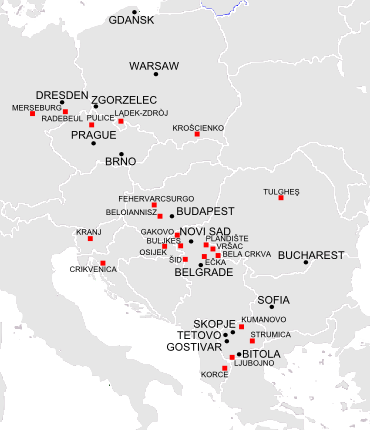
Many of these children were spread throughout the Eastern Bloc by 1950 there were 5,132 children in Romania, 4,148 in Czechoslovakia, 3,590 in Poland, 2,859 in Hungary and 672 had been evacuated to Bulgaria.

The official Greek position was that these children had been forcibly taken by the Communists to be brought up under a socialist system. The alleged abduction of children is referred to by Greek historians and politicians as the Παιδομάζωμα (Paidomázoma), an allusion to the Ottoman devşirme.

One major effect of the Macedonian exodus from Northern Greece was the effect of depopulation on the region of Greek Macedonia. This was most markedly felt in the Florina, Kastoria, Kozani and Edessa areas where the Communist party was popular and where the largest concentrations of Ethnic Macedonians could be found. Many of these depopulated and devastated villages and confiscated properties were given to people from outside of the area. 


Vlachs and Greeks were given property in the resettlement programme conducted by the Greek Government from the period 1952-58. Many properties were confiscated from those persons who had fled the war and had their citizenship subsequently stripped from them.

Law 1540/85 of April 10,1985 stated that political refugees could regain property taken by the Greek government as long as they were “Greek by genus”. This again excluded many people who were not "Greek by genus", namely the ethnic Macedonian refugees.

Citizenship was stripped from the evacuees without the fair hearing to an independent tribunal and other internationally accepted protocols for the seizure of citizenship such as legal representation and the opportunity to defend oneself. This process of seizing citizenship had "historically been used against people identifying as ethnic Macedonians". Despite it applying to all citizens regardless of ethnicity. 


It has been enforced, in all but one case, only against citizens who identified themselves as members of the "Macedonian" minority. Dual citizens who are stripped of Greek citizenship under Article 20 of the citizenship code are sometimes prevented from entering Greece using the passport of their second nationality. Although since 1998 there have been no new reported cases of this occurring.

Many people who had fled the country were also denied visa for re-entry into Greece. The refugees planned on attending weddings, funerals and other events but were denied access to Greece. These measures were even extended to Australian and Canadian citizens, many of whom have been barred from entering Greece. 


There have been claims that specifically the exiles who left Greece were especially targeted while other nationals from the Republic of Macedonia have had very little problems with entering Greece. The Greek Helsinki Monitor has called on the Greek government to stop using articles of the Citizenship code to deprive, "non-ethnic Greeks", of their citizenship.

_____________________________

Due to all of this, the refugee children took a lawsuit against Republic of Greece in from of the International court in The Hague. They are looking back for their property as well as the right for double citizenship. Estimated value of the lawsuit is around 40 billion euros.

Wednesday, September 30, 2009

FK Vardar

FK Vardar (Macedonian: ФК Вардар) is a football team from Skopje, Republic of Macedonia, that currently plays in the Macedonian First League. The club plays at the Philip II Arena (current capacity 25,000 - in construction).   The club was founded in 1947.  Vardar's most glorious moment came in 1987, when the team lead by Darko Pančev, Ilija Najdoski, Dragan Kanatlarovski, Čedomir Janevski and Vujadin Stanojkovic won the Yugoslav First League 1986-87 title.     By winning the league Vardar became the first and only Macedonian club to win the national Yugoslav Championship, temporarily breaking the dominance of the big four of Yugoslav football at that time; Red Star Belgrade, Partizan Belgrade, Dinamo Zagreb and Hajduk Split.        Vardar won the title from Partizan Belgrade by 1 point due to Partizan and 9 other teams starting the 1986-87 season with negative 6 points due to match fixing irregularities committed on the 34th and final round of the season before. The title was subsequently awarded to FK Partizan in 1988 when the points deductions were successfully appealed to the Yugoslav Constitutional Court.      
 
Vardar did however represent SFR Yugoslavia in the 1987-88 UEFA European Champions Cup where they lost in the first round to Porto of Portugal over two legs. See Yugoslav First League 1985-86.  Following the breakup of Yugoslavia and the formation of the Macedonian First League, Vardar established itself as the dominant club in the new competition, winning three consecutive league titles and two Macedonian Cups.     
 
For the next six years however the club experienced a relative dry spell, yet still winning two national cups. The club's fortunes looked up with the return of coach Gjoko Hadžievski, who led the club to another two titles.     
League Titles Yugoslav Champions    * 1987      
Macedonian Champions    * 1993  * 1994  * 1995  * 2002  * 2003           
Cup Titles Yugoslav Cup    * 1961       
Macedonian Cup    * 1993  * 1995  * 1998  * 1999  * 2007  
  Records
* Most Goals: Andon Doncevski (217 goals)    * Best Goals Per Game Average: Darko Pancev (207 matches/132 goals - 0.65 goals per match)    * Most goals in single season (Macedonian League): Saša Ćirić 1992/93 (36 goals)    * Most goals in European Competition: Wandeir 2003/04-05 (14 goals)    * Most Successful Coach: Gjoko Hadzievski (5 league titles, 2 national cups)
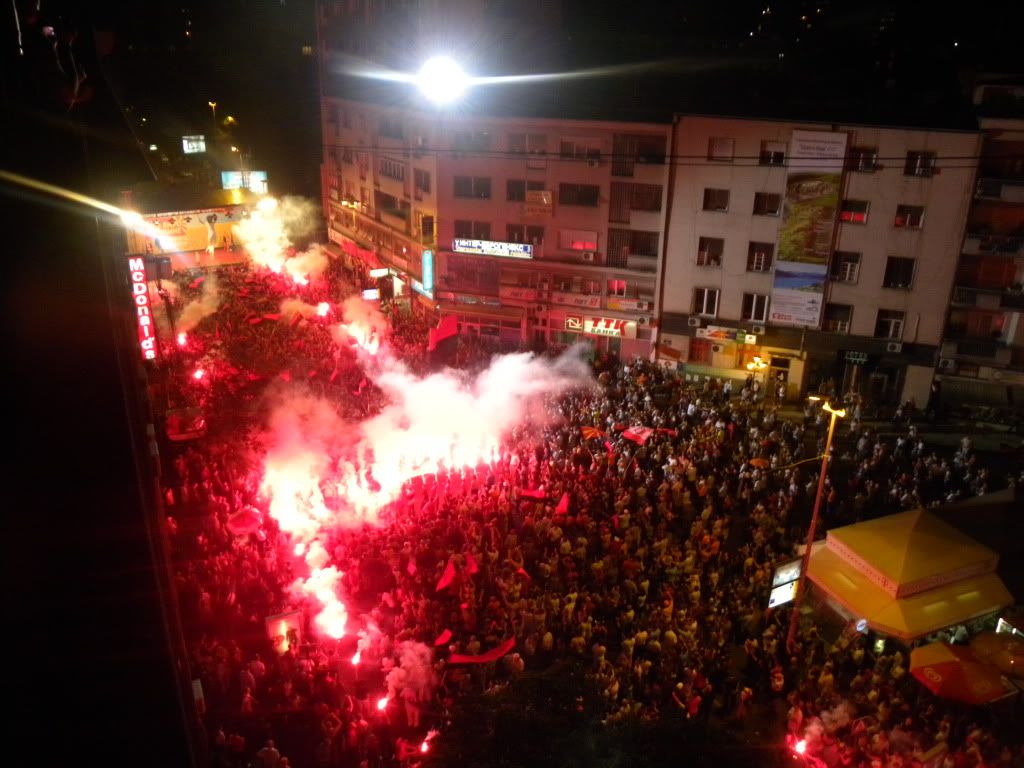
   FK Vardar supporters are known as Komiti and they were founded in 1987. 

Monday, August 31, 2009

Mariovo

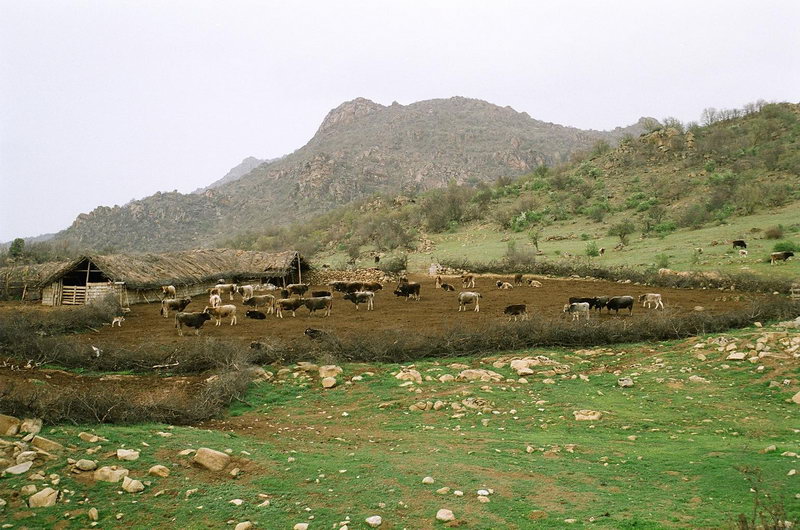
Mariovo (Macedonian Cyrillic: Мариово) is a mountainous region in southern Macedonia known for its traditional white costume. The area is somewhat large but since there has been no urban development in these spaces over the past century, the region contains no actual towns, only rustic villages. 

The largest village in Mariovo is Vitolište, situated in Prilep's municipality. Mariovo now is divided in three municipalities. Konopishte is in Kavadarci municipality, Vitolishte in Prilep municipality, and Staravina in Novaci municipality, as a part of Bitola's county.


It is said that Mariovo was named after the beautiful and brave girl Marija. The legend says that some turkish Pasha who has conquered the villages of Mariovo, has fallen in love with this girl and, enchanted by her beauty, was prepared to do everything to gain her love. 

But Marija's father was not approving on it, because his daughter was a Christian, and the Turk was a Muslim. The Pasha would not give up. Marija answered his persistence with one condition: she would become his wife, but the entire region, from the Poloski monastery, Selecka mountain, to the village by the name of Brod, then the Bitola region, the Nidze mountain and to the reach of Kozjak, to remain Christian and that not a single Turk should be inhabited there. The Pasha agreed to this condition, signed papers on that decision and took Marija with him.


He took her on the rood leading to the village of Dunje, Marija suddenly took the knife from her folds, and forcefully killed herself. Taking away her life, she did not surrender to the pasha, who later, although he wanted to, could not annul the contract he previously signed. 

By the power of this document, the guarantee that the entire region should remain Christian was respected. In the honor of the girl and her courageous act, the region was named Mariovo.


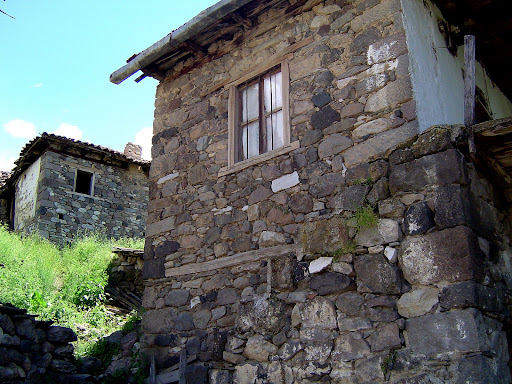
Mariovo is today almost completely deserted. Among the stones that make company to the large and fertile plains, among the many markings and directions that point the way to a temple of God or a shrine that once existed here, from time to time a fireplace can be observed, a house once in a while, the home to the most persistent who, besides everything, could not resist the extraordinary attractiveness of this picturesque region. 

And amid these fairly devastated houses from which the curious and a bit puzzled eyes of the shepherds greet you, in one of the old villages, Manastirec, a real surprise awaits you. Among the fragile buildings and unmentioned yards, almost in the center of the village, there is the opulent basilica, the monastery church St. Nikola, an elegant beauty that reminds of the past times of wealth and well-being.


Surrounded by the mountains of Selechka, Nidze, Kozjak, and Babuna, the region of Mariovo is one of the most interesting and most inaccessible areas in Macedonia. Its morphological features include barren and dry hills, deep stone river gorges, but also magnificent woodland areas in the higher regions of the mountains of Nidze, Kozjak, and Babuna.


In Vitolishta, Dunje, Staravina, and other villages, the ambience depicts the scenes and pictures of another, ancient time. Wild and cruel, yet quite picturesque, Mariovo land awakens interesting, pleasant, and mystic feelings in all who visit it.

Friday, August 21, 2009

Krusevo - ethno town

Krusevo (Macedonian: Крушево, Aromanian: Crushuva) also spelt Krushevo, is a town in the Republic of Macedonia. It's a picturesque mountain town. Situated at an altitude of 1,350 metres (4,400 ft), Krusevo is the highest town in the Republic of Macedonia. 

Krusevo is known for its many fine examples of 19th century domestic architecture. The town is full of old and more recent houses built in the style of old Macedonian architecture. The town of Krusevo is the seat of Krusevo Municipality.


The name of the town in other languages is:


* Aromanian: Crushuva
* Albanian: Krusheva
* Turkish: Kruşova, Kuruşova
* Greek: Κρουσοβώς

Krusevo is a living museum, famous for its traditional architecture, cultural sites, and legacy as the site of the great 1903 Ilinden uprising against Ottoman domination. The rebellion failed, but its memory is cherished in Macedonia even today, as a symbol of the national struggle for freedom and democracy; while it lasted only 10 days, the Krusevo Republic of revolutionary leader Nikola Karev represented a desire for self-rule under a modern European political system. 

Today an enormous monument on the hill above Krusevo marks the elusive dream of the Ilinden revolutionaries.


During the Ilinden Uprising in 1903 the rebels proclaimed a short lived Krusevo Republic. Having suppressed the uprising the city was almost completely destroyed by the Ottoman army.The republic known as Krusevska republika was established here in 1903 during the Ilinden insurrection. 

One of the most important points in the Ilinden uprising was the declaration of the "Manifesto of Krusevo". It called for all the people of Macedonia regardless of their nationality and religion to fight together against the Ottoman Empire and live peacefully in a free country of Macedonia.


The town is full of old and more recent houses built in the style of old Macedonian architecture. It is home to Meckin Kamen, an historical landmark which marks the spot of the uprising of 1903. On 2 August every year, it is the site of the traditional Macedonian Independence Day celebrations, which are attended by the President of Macedonia and other Macedonian political leaders.

Krusevo also hosts the "Makedonium" monument to the Ilinden Uprising and a number of museums of the Ilinden Uprising.The towns galleries include an exhibit of 19th century icons and a memorial to the master of modern Macedonian painting Nikola Martinovski who was born in this town.

Because of its elevation, Krusevo is one of Macedonia’s winter sports destinations; the same quality also makes this pine-forested getaway a comfortable destination in summer, when the Krusevo air stays cooler and more pure than in the arid lowlands.


There is a project called "Krusevo ethno-town", supported by the Ministry of Culture of the Republic of Macedonia, developed by few enthusiasts. 

According to that project, Krusevo shall look like a town from the beginning of the 20th century, while it was the center of the Macedonian Ilinden Uprising in 1903, leading to the creation of the first Republic on the Balkans "The Krusevo Republic". People will be dressed like Ottoman Turks and Macedonian revolutionary freedom fighters. The project wants to make Krusevo a main tourist destination in five years.